For many homeowners across the South East and East Anglia, one of the biggest questions about solar panels is simple:
“How much will my electricity bills actually go down?”
With rising electricity costs, increasing energy demand and growing interest in energy independence, solar panels have become one of the most practical long term investments for UK households.
At SolarTherm UK, we regularly speak to homeowners who want clear, honest information – not exaggerated claims. That is why before and after energy bill comparisons are one of the most useful ways to understand the real financial impact of solar.
In this guide, we explain:
- What a typical solar bill reduction looks like
- A real example of before and after electricity usage
- What affects solar savings in UK homes
- How battery storage changes energy bills
- What homeowners in Essex, Kent, Suffolk and the wider South East and East Anglia can realistically expect.
What Is the Average Monthly Electricity Bill With Solar Panels in the UK?
The average monthly electricity bill with solar panels in the UK varies from household to household. The amount you pay depends on how much electricity you use, how much your solar panels generate, when you use that electricity and whether you have battery storage.
Solar panels reduce the amount of electricity you need to buy from your energy supplier by generating electricity for your home. If you generate more electricity than you need during the day, a battery can store the surplus for use in the evening or overnight, helping you reduce your reliance on the National Grid.
However, installing solar panels does not necessarily mean your electricity bill will disappear completely. Most grid-connected households will continue to pay a standing charge, which covers the cost of maintaining their connection to the electricity network. You may also need to import electricity when your solar panels are not generating enough to meet your household’s demand.
A Real Example: Electricity Bills Before and After Solar Panels
Actual electricity bills provide a useful illustration of how solar panels and battery storage can reduce the amount of electricity a household buys from the grid.
At SolarTherm UK, one household’s bills show the following:
| Bill detail | Before solar | After solar |
|---|---|---|
| Billing period | March 2023 (19 days) | June 2025 (30 days) |
| Total electricity charges | £117.55 | £15.61 |
| Electricity imported from the grid | 313.5 kWh | 3.8 kWh |
| Standing charge | £7.05 | £13.94 |
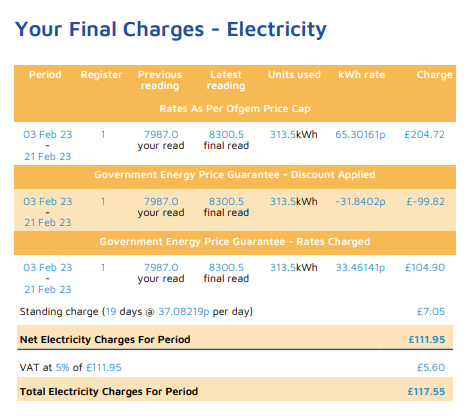
Before solar was installed, the household paid £117.55 for electricity over a 19-day billing period, including £7.05 in standing charges. The bill recorded 313.5 kWh of electricity imported from the grid.
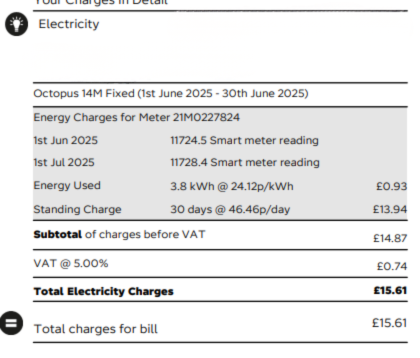
After solar installation, the household’s June 2025 bill totalled £15.61 for 30 days. Grid electricity consumption had fallen to just 3.8 kWh, although the household still paid £13.94 in standing charges.
This example demonstrates how substantially solar panels and battery storage can reduce the amount of electricity purchased from an energy supplier. It also illustrates why a household can have a very small electricity bill for energy consumed but still have charges to pay.
It is important to note that these bills cover different periods and use different electricity tariffs. They are genuine before-and-after examples, rather than a like-for-like monthly comparison, so they should not be used to calculate a precise monthly or annual saving for this household.
What Affects Your Electricity Bill After Installing Solar Panels?
Several factors determine how much you will pay for electricity after installing solar panels:
- System size and solar generation: The amount of electricity your system generates depends on its capacity, roof orientation, shading and the time of year.
- Household electricity usage: Using appliances while your panels are generating electricity allows you to use more of your solar power directly.
- Battery storage: A battery stores surplus solar electricity for later use, potentially reducing the amount you need to buy from the grid during the evening.
- Electricity tariffs: Your unit rate determines how much you pay for electricity imported from your supplier.
- Standing charges: These generally remain payable regardless of how little electricity you import.
- Seasonal changes: Solar generation typically varies throughout the year, so your electricity bill may be higher during winter than in summer.
The best way to estimate your potential savings is to assess your household’s electricity consumption, available roof space, expected solar generation and usage patterns. Adding battery storage may further reduce grid imports, depending on how and when your household uses electricity.
At SolarTherm UK, we help homeowners across Essex, Kent, Suffolk and the wider South East find solar PV and battery storage solutions suited to their property and energy requirements.
Why Homeowners Are Comparing Before and After Solar Bills
Electricity prices in the UK have increased significantly over recent years. Many homeowners are now looking for ways to:
- Reduce monthly energy costs
- Protect themselves from future price rises
- Use more self-generated electricity
- Increase home value
- Improve EPC ratings
- Reduce reliance on the grid
Solar panels help homeowners generate their own electricity during daylight hours, reducing the amount of power purchased from energy suppliers. When paired with battery storage, homeowners can also store surplus electricity for use during the evenings and overnight – increasing self-consumption and savings even further.
Average Before and After Solar Bill Comparison
Below is a typical example of what many UK homeowners experience after installing solar panels.
| Property Details | |
| Location | Chelmsford, Essex |
| Solar system size | 5.6kWp |
| Battery storage | 7.2kWh |
| Annual electricity usage | ~5047.7kWh |
Before Solar Installation
| Monthly electricity bill | £117.55 |
| Estimated annual electricity cost | £1,689.03 |
| Unit price | 33.46141p per kWh |
| Grid dependence | High |
After Solar Installation
| Monthly electricity bill | £15.61 (£13.94 of this is standing charge) |
| Estimated annual electricity cost | £382.51 |
| Unit price | 46.46p per kWh |
| Estimated annual savings | £1,306.52 |
| Grid dependence | Low |
Total Estimated Reduction: 77.35%
What Affects Solar Savings?
Not every homeowner will achieve identical savings. Several factors influence before and after bill reductions.
Solar System Size
Larger systems generate more electricity. A homeowner with a 6kWp solar system will usually reduce bills more than a homeowner with a 3kWp system. The right size depends on roof space, electricity usage, budget and future energy plans. For many households in the South East and East Anglia, adding battery storage can significantly improve the return on investment.
Battery Storage
Battery storage is one of the biggest factors affecting after solar electricity bills. Without a battery, unused daytime solar electricity is exported back to the grid. With a battery, surplus solar energy can be stored and used later in the evening when electricity demand is higher.
This often leads to:
- Higher self-consumption
- Lower grid imports
- Better long term savings
- Improved energy independence
For many households in the South East and East Anglia, adding battery storage can significantly improve the long term return on investment.
Household Energy Usage
Homes using more electricity during daylight hours generally benefit most from solar panels. Remote workers, families at home during the day, retired homeowners, heat pump owners and EV owners charging during daylight hours benefit more as they are using more power when their panels are generating free electricity.
Roof Direction and Shading
South-facing roofs usually produce the highest solar output in the South East and East Anglia. However, east- and west-facing roofs can still perform extremely well and my better match household energy usage patterns. If possibly splitting your panels between both an east- and west-facing roof can generate optimal results, capturing both early morning and late afternoon sunlight.
Nearby trees, chimneys or neighbouring buildings can cause shading which can affect performance, a profession system design can overcome these issues with clever planning and smart technology.
Can Solar Panels Eliminate Electricity Bills Completely?
Solar panels can dramatically reduce your electricity bills, but they will not necessarily eliminate them completely. The amount you save depends on how much electricity your solar PV system generates, how much your household consumes, whether you have battery storage and the terms of your electricity tariff.
When your solar panels generate electricity, your home can use that power instead of importing electricity from the National Grid. The more of your own solar generation you use, the less electricity you generally need to purchase from your energy supplier.
However, most homes remain connected to the grid, allowing them to import electricity when their solar panels are not generating enough to meet demand.
Do You Still Have to Pay for Electricity With Solar Panels?
Yes, most homeowners with solar panels will continue to receive electricity bills. There are several reasons for this.
Standing charges still apply. If your property remains connected to the electricity network, you will generally continue to pay a daily standing charge. This covers the cost of maintaining your connection and is payable even when you import very little electricity.
Solar generation varies throughout the day. Your panels generate electricity during daylight hours, with output affected by the weather, season, roof orientation and shading. They do not generate electricity at night, so your home may need to import electricity from the grid when demand exceeds the power available from your system.
Your household may use more electricity than your system generates. If you run several appliances simultaneously, charge an electric vehicle or use substantial amounts of electricity in the evening, you may still need to purchase electricity from your supplier.
Solar panels can therefore reduce the amount you pay for electricity without removing every charge from your bill.
Why Is My Electricity Bill Still High After Installing Solar Panels?
If you have solar panels but your electricity bills remain higher than expected, several factors could explain why.
- High evening electricity consumption: If most of your electricity is used after sunset, you may import more electricity unless you have sufficient battery storage.
- Limited solar generation: A small system, shaded roof or reduced winter sunlight can limit the electricity available for your home.
- Battery storage settings: A battery may not be charging fully from solar generation, or its settings may prioritise other operating modes.
- High electricity unit rates: Even relatively modest grid imports can be expensive if your tariff has a high unit rate.
- Standing charges: These remain payable in most circumstances, regardless of how much electricity you import.
- Unexpected energy consumption: Appliances, heating systems, hot water demand and electric vehicle charging can increase your overall electricity requirements.
If your bills appear unusually high, check your electricity import readings, solar generation figures and battery settings. If generation is significantly below expectations, your installer may be able to investigate whether the system is operating correctly.
How Can Battery Storage Reduce Your Electricity Bill Further?
A solar battery stores surplus electricity generated during the day so you can use it when your panels are producing less or no electricity.
Without a battery, excess electricity that your household cannot use immediately may be exported to the grid. You may then need to buy electricity later when your panels are no longer generating enough power.
With a suitably sized battery, more of that surplus generation can be stored for evening and overnight use. This can reduce your grid imports and increase the proportion of your household’s electricity supplied by your own solar system.
The potential savings depend on your battery capacity, household consumption, solar generation and electricity tariff. A battery will not necessarily eliminate grid imports, particularly during periods of low solar generation or unusually high demand.
Can You Get Paid for Excess Solar Electricity?
Yes. Eligible homeowners may be able to receive payments for surplus electricity exported to the grid through the Smart Export Guarantee (SEG) or another export tariff offered by an energy supplier.
Export payments can provide an additional financial benefit from your solar installation. However, they are separate from the reduction in your electricity bill.
Your overall financial benefit may include:
- Reduced electricity purchases: You buy less electricity from your supplier by using your own solar generation.
- Battery storage benefits: You can store surplus generation for use when your panels are not producing enough electricity.
- Export payments: You may earn money for electricity exported to the grid under an eligible tariff.
The best balance between using, storing and exporting electricity depends on your household’s needs and the tariffs available to you. Exporting electricity is not always the most financially beneficial option if that electricity could instead be stored and used later to avoid buying more expensive electricity from the grid.
What Is the Best Way to Reduce Your Electricity Bill With Solar Panels?
To maximise the financial benefits of solar panels, consider using energy-intensive appliances during daylight hours, reviewing your electricity tariff and assessing whether battery storage would suit your household’s consumption patterns.
A properly designed solar PV system, potentially combined with battery storage, can substantially reduce your reliance on grid electricity. However, the best results come from matching the system to your property’s generation potential and your household’s energy requirements.
At SolarTherm UK, we help homeowners across Essex, Kent, Suffolk and the wider South East assess their electricity usage and explore solar PV and battery storage solutions designed to reduce electricity costs.
Solar Export Payments Can Further Reduce Costs
Many energy suppliers now offer Smart Export Guarantee (SEG) tariffs. This means homeowners can get paid for surplus electricity exported to the grid. Export payments vary by supplier, tariff and export patterns, so it is beneficial to shop around. At SolarTherm UK, we find Octopus Energy’s Flux tariff offers preferential rates to existing customers who import electricity. For some households, export payments create additional annual savings alongside lower electricity bills.
Realistic Savings for South East and East Anglia Homeowners
Homes in the South East and East Anglia often perform particularly well for solar generation because these regions receive higher than average solar irradiation levels compared to other regions of the UK.
A professionally designed system can provide substantial long term savings when matched correctly to household usage.
Why Professional Installation Matters
The difference between average and excellent solar savings often comes down to system design and installation quality. At SolarTherm UK, every system is designed around the property’s roof layout, energy usage and future electricity goals. We believe homeowners should receive honest projections based on realistic performance data – not inflated estimates.
Why Homeowners Choose SolarTherm UK
SolarTherm UK provides residential solar installations across Essex, Kent, Suffolk, Hertfordshire and the wider South East and East Anglia.
We focus on:
- High quality solar panel systems
- Honest performance and returns estimates independently verified by EPVS for accuracy
- Professional installation standards
- Battery storage integration
- Long term customer support
- Tailored system design
Our team understands the specific energy requirements of South East and East Anglian homeowners and design systems built for long term efficiency, reliability and savings.
Final Thoughts
Before and after electricity bill comparisons help homeowners understand the real value of solar panels. While every property is different, a professionally designed solar system can significantly reduce electricity costs and improve long term energy efficiency.
For homeowners across the South East and East Anglia, solar continues to be one of the most effective ways to reduce dependence on rising energy prices.
Contact SolarTherm UK today for a free, no obligation quote and design, tailored to your property, usage and future energy needs. No hard sell, just honest, expert advice – and the time you need to make an informed decision.
Your home. Your energy. Your future.
Frequently Asked Questions
There is no single average monthly electricity bill for UK homes with solar panels, as costs depend on household consumption, solar system size, battery storage and electricity tariffs. Solar panels can reduce the amount of electricity you buy from your supplier, but standing charges and electricity imported from the grid may still apply.
Solar panels can substantially reduce electricity bills by generating power for your home. Your savings depend on how much electricity your system produces and how much you use directly rather than importing from the grid. Battery storage can help you use more of your solar generation during the evening and overnight.
Yes, most households with solar panels will continue to receive electricity bills. You will generally still pay a daily standing charge while connected to the grid, and you may need to import electricity when your panels are not generating enough to meet your household’s demand.
Solar panels can reduce your electricity costs considerably, but eliminating your entire bill is uncommon for a grid-connected household. Standing charges usually remain payable, and you may still need electricity from the grid at night or during periods of low solar generation.
High electricity bills after installation can result from substantial evening usage, limited solar generation, high import rates, insufficient battery storage or unexpectedly high household consumption. Check your electricity import readings, solar generation figures and battery settings to understand where your electricity is coming from.
Solar generation depends on the installed system capacity, roof orientation, shading, location and weather conditions. A larger, suitably positioned system will generally generate more electricity than a smaller system, although actual output varies throughout the year. An installer can estimate annual generation based on your property’s characteristics.
Yes, solar panels generate electricity throughout the year, including winter. However, shorter daylight hours and lower solar irradiance generally mean generation is lower than during the summer. You may therefore need to import more electricity from the grid during winter.
A solar battery can reduce electricity bills by storing surplus solar generation for use when your panels are producing less electricity. The savings depend on battery capacity, household consumption, charging strategy and electricity tariffs. A battery may be particularly useful for households that use substantial amounts of electricity in the evening.
Yes, eligible homeowners may receive payments for electricity exported to the grid through the Smart Export Guarantee (SEG) or another eligible export tariff. The amount you receive depends on your supplier’s tariff and how much electricity you export. Export payments are separate from the savings made by buying less electricity.
The most cost-effective option depends on your electricity import rate, export tariff and household usage. Using your own solar electricity can avoid purchasing electricity from your supplier, while exporting surplus electricity may earn you a payment. A battery can help you store surplus generation for later use, but whether this is financially worthwhile depends on your circumstances.
Use energy-intensive appliances during daylight hours where practical, monitor your solar generation and electricity imports, review your energy tariff and consider whether battery storage would suit your usage patterns. These steps can help you use more of your own solar electricity and reduce your reliance on the grid.
Solar panels can be worthwhile for homeowners who want to reduce their reliance on grid electricity and manage long-term energy costs. The financial benefits depend on installation costs, electricity prices, system performance, self-consumption and any export payments. A property-specific assessment can help establish whether solar is a suitable investment for your home.