When you’re investing in solar panels for your home or business, one of the first big decisions is which panel type to choose – monocrystalline or polycrystalline.
Both convert sunlight into clean, free electricity, both can cut your energy bills and carbon footprint, but they both perform differently, look different and come with different price tags. At SolarTherm UK, we install both options across the South East and can help you match the right solar panels to your roof, budget and energy goals.
What’s the Difference Between Monocrystalline and Polycrystalline Solar Panels?
Both panel types are made from silicon, but they’re manufactured differently and that shapes how they behave on your roof.
| Feature | Monocrystalline Solar Panels | Polycrystalline Solar Panels |
| Cell colour | Deep black, uniform finish | Blue, speckled / marbled appearance |
| Silicon structure | Single crystal of silicon | Multiple silicon crystals melted together |
| Typical efficiency | 18–23% | 13–18% |
| Space required | Less roof space for the same output | More roof space needed |
| Upfront cost | Higher per panel / per watt | Lower per panel / per watt |
| Best for | Space-limited roofs, premium aesthetics, max output | Larger roofs, budget-conscious installs |
In simple terms:
- Monocrystalline solar panels – higher efficiency, more power per m², smarter look, higher price
- Polycrystalline solar panels – more affordable, perfectly capable, but need more space
Monocrystalline Solar Panels
How They’re Made
Monocrystalline solar panels are manufactured from a single, pure crystal of silicon. The crystal is grown into a cylinder and sliced into thin wafers, turning them into the black cells you see on premium solar panels. This uniform crystal structure lets electrons move more easily through the cell, which is why monocrystalline panels are more efficient.
Key Benefits
- Higher efficiency – typically 18-23% meaning you get more electricity from less roof space, ideal for smaller or shaded roofs in towns and cities across Essex, Kent and the wider South East.
- Better in low light – they generally perform better on cloudy days, at dawn and dusk and in winter, so you’ll be making the most of every bit of sunlight.
- Space saving – monocrystalline solar panels often make larger systems on smaller roofs more viable as they take up less space per kilowatt of power.
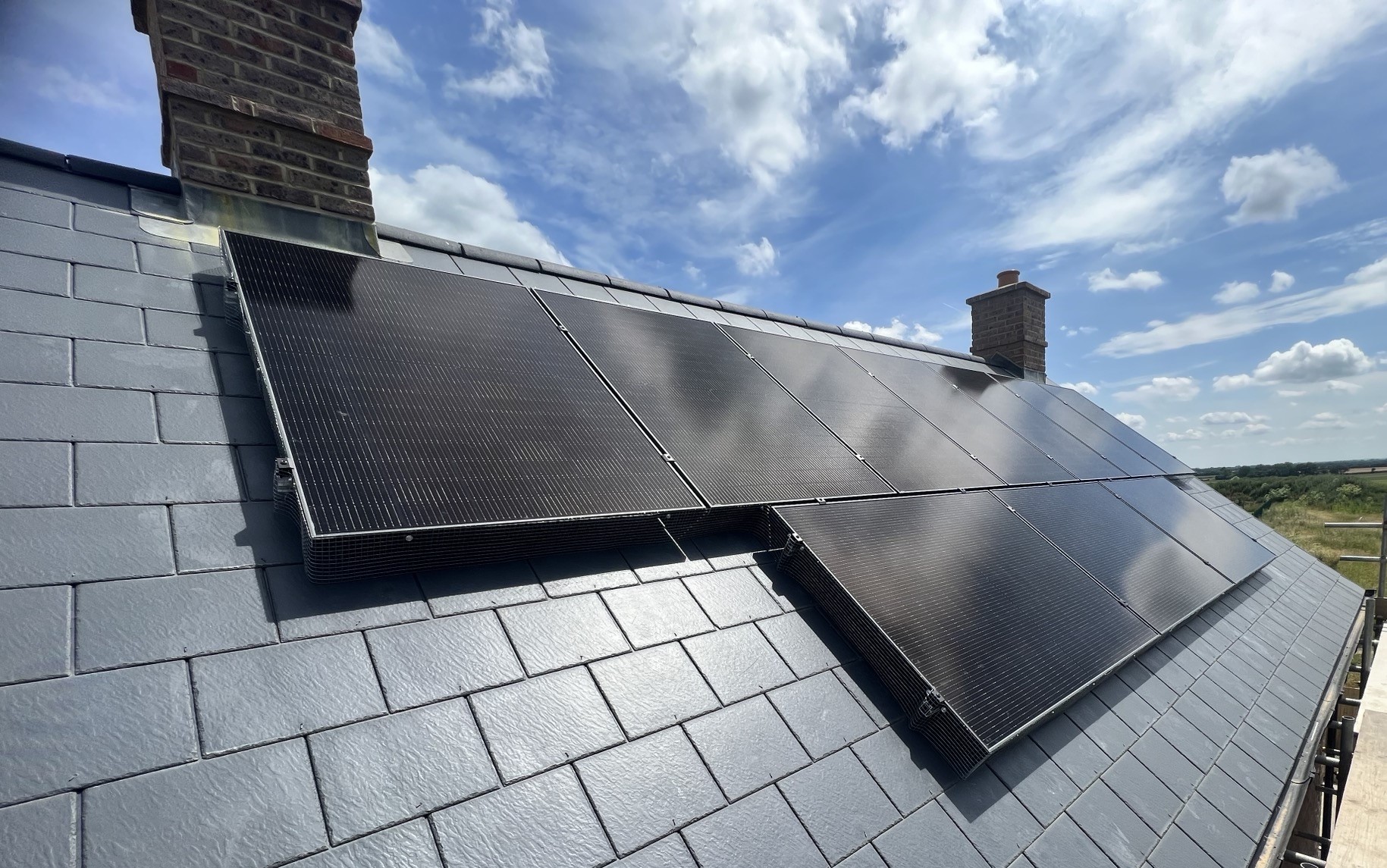
- Sleek, black look – many homeowners prefer the all black aesthetic, especially on modern properties or visible street facing roofs.
Things to Consider
- Higher upfront costs – the more complex manufacturing process means monocrystalline solar panels cost more per watt than polycrystalline.
- More sensitive to shading – as with most solar panels, small shaded areas can affect output. Good system design and SolarEdge power optimisers can mitigate this.
Best Use Cases
Monocrystalline solar panels are usually the best choice if:
- Your roof space is limited
- You want maximum output per m²
- You prefer a clean, black finish
- You’re planning a high performance system with battery storage
Polycrystalline Solar Panels
How They’re Made
Polycrystalline solar panels are created by melting multiple silicon crystals together and casting them into a block. Once cooled, the block is sliced into wafers. As the silicon structure is fragmented, electrons don’t travel quite as freely, which is why efficiency is usually lower.
Key Benefits
- Lower cost – the simpler manufacturing process means polycrystalline solar panels are usually cheaper per watt, making them attractive if you want to keep upfront costs down.
- Great for larger roofs – if you’ve got plenty of space, slightly lower efficiency isn’t a problem, you simply install more panels.
- Solid performance and reliability – despite the lower efficiency, polycrystalline panels still typically offer 25+ year lifespans and strong performance in UK weather conditions.
Things to Consider
- Slightly lower efficiency – you’ll need more panels and more space to achieve the same system size as monocrystalline solar panels.
- Blue, speckled appearance – some homeowners don’t like the blue, grainy look, especially on very visible roofs.
- Temperature performance – in higher temperatures their efficiency can drop more than monocrystalline solar panels.
Best Use Cases
Polycrystalline solar panels are often ideal if:
- You have ample roof or ground space
- You want to minimise upfront costs
- You’re installing solar panels on outbuildings, farm roofs or industrial units
Temperature, Efficiency and UK Weather
Both monocrystalline and polycrystalline solar panels lose a little efficiency as they get hotter. Monocrystalline panels have a slightly better temperature coefficient, meaning they maintain their performance more effectively during warm spells.
Cost, Payback and Return on Investment
Exact prices vary by system size, roof type and hardware, but as a guide:
Monocrystalline systems
- Higher cost per watt
- Higher annual generation
- Often better long term savings, especially where space is limited
Polycrystalline systems
- Lower upfront costs
- Slightly lower annual generation
- Great where you can install more panels without running out of space
In Essex, Kent, Surrey and the surrounding South East, many SolarTherm UK customers are seeing:
- Payback periods typically around 6-10 years, depending on system size, usage and tariff
- Ongoing savings for decades, especially when combined with battery storage and smart use of daytime loads
UK Solar Incentives Relevant to Essex, Kent and Surrey
When you invest in solar panels with SolarTherm UK, you can benefit from several UK-wide schemes (subject to eligibility and current rules), including:
- 0% VAT on domestic solar panels (until 2027) – makes installing solar panels and batteries more affordable for homeowners.
- Smart Export Guarantee (SEG) – get paid for exporting surplus solar electricity back to the grid through your energy supplier.
- Other grants and schemes – depending on your circumstances, there may be additional local or national schemes designed to support low income households or improve energy efficiency.
We always recommend checking the latest incentives and we can talk you through what’s available when we quote for your solar panels in Essex, Kent or Surrey.
Environmental Impact: Monocrystalline vs Polycrystalline
Both monocrystalline and polycrystalline solar panels have an environmental cost in manufacturing, but both dramatically reduce emissions over their lifespan compared to fossil fuels.
Both types of panels usually repay the energy used to make them withing just a few years of operation. A well designed solar system can cut over a tonne of CO₂ emissions every year.
Recycling for solar panels is improving, with over 90% of the materials used in solar panels that can be recycled.
Whichever panel you choose, installing solar panels with SolarTherm UK is a powerful step towards a low carbon, more sustainable home.
Which Solar Panels Are Best for Your Roof?
At SolarTherm UK when we design your solar PV system we take into account:
- Your budget
- Available space – either on your roof or ground space
- Roof orientation and shading
- Your current electricity usage and your plans for the future
- Whether you want battery storage
- How important aesthetics are to you
From this information we design a system that works best for your property, only recommending the products that work well to provide you with an efficient system that generates enough electricity to power your home.
Ready to Start the Solar Journey?
Contact SolarTherm UK today for a free, no obligation quote and design, tailored to your property, usage and future energy needs. No hard sell, just honest, expert advice.
Your home. Your energy. Your future.
FAQs
Which type of solar panel offers better performance?
In most cases, monocrystalline solar panels offer better performance thanks to higher efficiency and better low-light behaviour. They generate more electricity per square metre, which is valuable for smaller roofs in built-up parts of Essex, Kent and Surrey.
Which solar panels are best for residential homes?
For typical homes, monocrystalline solar panels are usually preferred because of their compact size and neat appearance. However, if you have a large, unobstructed roof and want to minimise upfront cost, polycrystalline can still be a smart choice.
What are the main benefits of polycrystalline solar panels?
- Lower initial cost
- Good reliability and lifespan
- Ideal for larger roofs and ground-mounted systems
- A cost-effective way to install a larger total system size
What are the downsides of polycrystalline solar panels?
- Lower efficiency, so they require more space for the same kW output
- Blue, speckled appearance some homeowners find less attractive
- Slightly weaker performance in low light and higher temperatures compared with premium monocrystalline panels