A Step By Step Guide to Solar PV
If you’re researching how solar panels work, you’re not alone. It’s one of the most searched solar questions in the UK – and a key topic in the “People Also Ask” section on Google.
This guide explains, step by step, how a solar PV system generates electricity, how power is converted from DC (direct current) to AC (alternating current) and how that electricity is used in your home. Whether you’re considering solar in the South East or simply building your knowledge, this page is designed to give you clear, technically accurate answers.
Step 1: Sunlight Hits the Solar Panels
Solar panels are made up of photovoltaic (PV) cells, usually manufactured from silicon. When daylight hits the surface of the panel, light particles (photons) strike the silicon cells and energy is transferred to electrons within the material. Electrons then become energised and start moving. This movement of electrons creates an electrical current. This process is knows as the photovoltaic effect.
Key Point: solar panels generate electricity from light, not heat. That’s why they work efficiently even on cloudy days in the UK.
Step 2: PV Cells Generate Direct Current (DC)
Each PV cell produces a small amount of electricity. Cells are wired together inside a panel, and panels are connected to form a full solar PV system. These electricity produced at this stage is direct current, a one-directional flow of electrons and not directly usable by most household appliances. You home, runs on alternating current (AC). That’s where the inverter comes in.
Step 3: The Inverter Converts DC to AC
The inverter is the central control unit of your solar panel system. It’s primary function is:
Convert DC electricity from your solar panels into usable AC electricity for your home.
Technically, the inverter rapidly switches the DC flow back and forth to simulate the alternating waveform required by UK grid standards (230V, 50Hz).
There are three main types of inverters; string inverters, microinverters and hybrid inverters. Once converted, the electricity can power lights, appliances, EV chargers and heating systems.
Step 4: Electricity Powers Your Home First
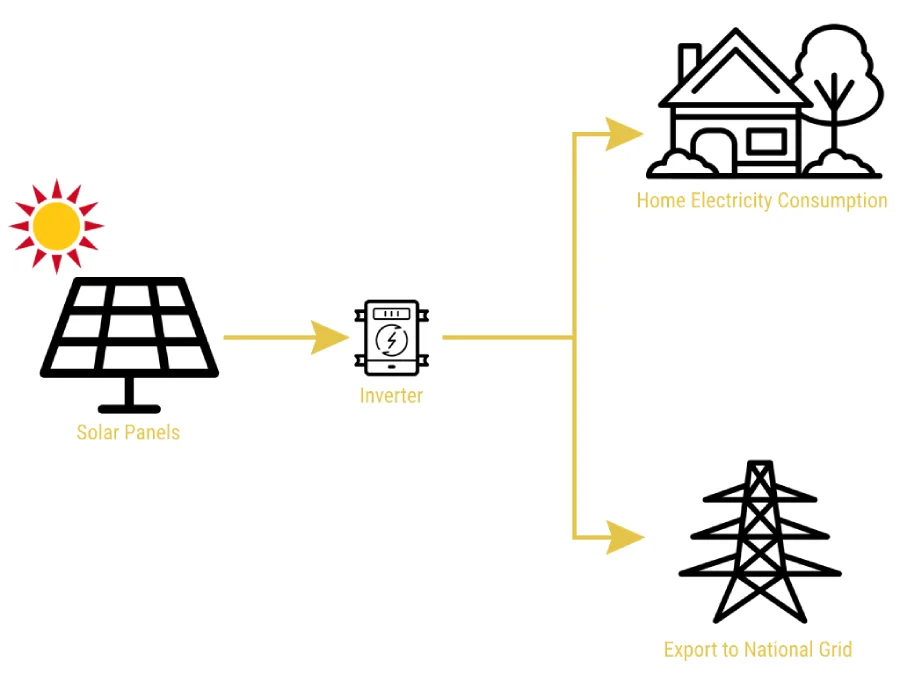
Your solar PV system is designed to prioritise self-consumption. The energy flow works like this:
- Solar panels generate electricity
- Inverter converts DC → AC
- Electricity flows to your consumer unit
- Your home uses the power in real time
If your home needs 2kW and your system is producing 3kW, that surplus 1kW can either be exported to the grid or stored in a battery.
Step 5: Solar Battery Storage (Optional)
If you install solar battery storage, surplus electricity is stored instead of being exported to the grid. This stored energy can then be used in the evenings, overnight and during low generation periods. Battery storage can also be used to optimise your system to avoid importing electricity during peak tariff windows. Some battery storage systems can be enabled for backup power in the event of a grid power failure.
Battery storage increases self-consumption and reduces grid reliance – particularly useful in the South East where electricity prices remain high.
How Do Solar Panels Work With the National Grid?
Most UK systems are grid connected. When you system produces more electricity than your home is using (and your battery is full) surplus electricity is exported to the grid for payments through the Smart Export Guarantee (SEG). When solar production is low you can import electricity from the grid as normal.
Your home will seamlessly switch between solar, battery and grid supply.
The Science Behind the Photovoltaic Effect (Simplified)
At a technical level:
- Silicon is doped to create a positive (p-type) and negative (n-type) layer
- The junction creates an electric field
- Photons dislodge electrons
- The electric field forces electrons in one direction
- Current is captured by conductive metal contacts
This is solid state semiconductor physics – no moving parts, no combustion, no noise. That simplicity is why solar PV systems are reliable and low maintenance.
Why Understanding How Solar Panels Work Matters
Understanding the process helps homeowners evaluate installer claims and compare system designs and decide on whether battery storage is worth it. Payback calculations become easier to understand and performance and returns estimates become less daunting, giving you increased confidence in your decision before you invest.
At SolarTherm UK we believe informed customers make better decisions. Our goal is to provide technically accurate, unbiased solar knowledge to homeowners across the South East.
Find out how much you can save with a solar PV installation and battery storage system by using our Solar Calculator.
Smart solar starts with the right advice.
FAQs
Do solar panels work on cloudy days in the UK?
Yes. Solar panels generate electricity from daylight, not direct sunshine. Output is reduced in heavy cloud, but systems still produce energy year-round.
Do solar panels work in winter?
Yes. Generation is lower due to shorter daylight hours, but cold temperatures can actually improve panel efficiency.
How long do solar panels last?
Most high-quality solar panels have:
- 25–30 year performance warranties
- 80–90% output guarantee after 25 years
Inverters typically last 10–15 years before replacement.
How much electricity does a solar PV system produce?
Production depends on:
- System size (kWp)
- Roof orientation and pitch
- Shading
- Location
In the South East of England, a well-positioned 4kWp system typically generates approximately 3,400–4,200 kWh per year.
What happens if the power goes out?
Standard grid-tied solar systems automatically shut down during a power cut for safety reasons.
However, systems with battery storage and backup functionality can continue supplying essential circuits.